
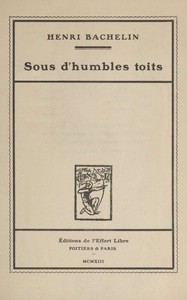
Sous d'humbles toits by Henri Bachelin
Henri Bachelin's 1913 novel, Sous d'humbles toits, is a masterclass in finding the epic in the everyday. Forget sweeping landscapes and grand adventures. The entire world of this book is contained within the walls of a simple, struggling household in a French village.
The Story
We follow the Fauconnier family: the father, Jean, a wheelwright whose work is fading; the mother, Marie, who manages the home with weary determination; and their adult son, Pierre, who feels stuck and dreams of something more. There's no single explosive event. The plot is built from the accumulation of small moments—a tense meal, a worry about money, a fleeting memory of youth, a silent resentment. The drama comes from the friction of three people living in close quarters, bound by love and duty, yet isolated by their private struggles. Bachelin shows how poverty isn't just a lack of coins; it's a weight on the spirit, narrowing choices and coloring every thought.
Why You Should Read It
I was amazed by how modern this over-a-century-old book feels. Bachelin doesn't judge his characters. He just shows them with incredible empathy. You feel the mother's exhaustion in her aching bones, the father's quiet pride in his skilled hands, and the son's restless frustration. It's a slow, immersive read that makes you pay attention to the details of ordinary life. The beauty isn't in fancy prose, but in the raw honesty of the emotions. It made me think about my own family, the unspoken tensions, and the quiet sacrifices that go unnoticed.
Final Verdict
This isn't a book for someone craving action or plot twists. It's for the reader who loves character studies and doesn't mind a slower pace. Think of it as the literary equivalent of a thoughtful, black-and-white film. If you enjoyed the quiet intensity of novels by Émile Zola or the focused domestic scenes in some of George Eliot's work, you'll find a lot to love here. Perfect for a rainy afternoon when you're in a reflective mood, ready to be pulled into a fully realized, humble world.
No rights are reserved for this publication. It is available for public use and education.
David Thomas
1 year agoJust what I was looking for.




Lucas Jones
1 year agoEssential reading for students of this field.