
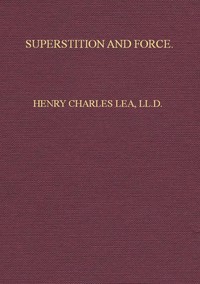
Superstition and Force by Henry Charles Lea
Let's be clear from the start: 'Superstition and Force' is not a novel. There's no main character to follow, but the 'story' it tells is one of the most important dramas in human history—the invention of law.
The Story
Henry Charles Lea walks us through the courtroom of the past, and it looks nothing like today. For centuries, across Europe, people didn't rely on lawyers, witnesses, and juries. Instead, they put their faith in rituals they believed God would judge. The book details three major types of these 'ordeals.' The 'Ordeal of Fire' meant carrying a hot piece of metal; if your wound healed cleanly, you were innocent. The 'Ordeal of Water' involved being thrown into a river; if you floated (rejected by the 'pure' water), you were guilty. Then there was 'Trial by Combat,' where the winner of a duel was declared legally right, with God guiding their hand. Lea traces how these practices were rooted in a worldview where divine will was expected to intervene directly in human affairs. The plot, so to speak, is the slow unraveling of this system. He shows the growing doubts, the clerical reforms, and the gradual shift toward needing actual proof—like documents and witness accounts—instead of a burned hand or a duel's outcome.
Why You Should Read It
What makes this 19th-century history book so compelling is how it connects to now. It makes you appreciate the sheer amount of struggle it took to build a legal system based on reason. Every time you hear about 'innocent until proven guilty' or 'the burden of proof,' you'll understand it as a hard-won victory against superstition. Lea doesn't just list facts; he shows the human logic behind the madness. You start to see how, in a world without forensic science, trusting in a higher power to reveal the truth might have felt like the most reliable system available. It completely reframes our modern justice system not as a given, but as a fragile and precious achievement.
Final Verdict
This book is perfect for anyone with curiosity about where our world came from. It's for fans of history, true crime, legal dramas, or anyone who enjoys a good 'how did we get here?' story. It's dense at times, but the ideas are so powerful they pull you through. You won't look at a courtroom, or even a simple argument, the same way again. It’s a brilliant reminder that progress is rarely a straight line, but a messy, centuries-long argument with our own beliefs.
No rights are reserved for this publication. You do not need permission to reproduce this work.
Ava Taylor
1 year agoAfter hearing about this author multiple times, the character development leaves a lasting impact. One of the best books I've read this year.
Donna Moore
6 months agoBased on the summary, I decided to read it and it challenges the reader's perspective in an intellectual way. Exceeded all my expectations.






Michael Taylor
5 months agoI was skeptical at first, but the flow of the text seems very fluid. Highly recommended.