
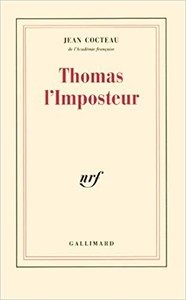
Thomas l'imposteur by Jean Cocteau
Jean Cocteau's Thomas l'imposteur (Thomas the Impostor) is a novel that feels like a dream about a war. Published in 1923, it's not a traditional war story of trenches and strategy. It's about the space between truth and illusion, and how fragile that line can become.
The Story
The story follows Guillaume Thomas, a sensitive sixteen-year-old in Paris during World War I. On a whim, he impersonates the nephew of a celebrated French general. The lie is effortless and instantly successful. He's given a uniform, papers, and a mission. He joins the war effort, attaching himself to a unit that includes the Princesse de Bormes, a wealthy woman serving as a nurse. In this bubble, his invented identity is everything. He drives an ambulance, visits the front, and is celebrated. The soldiers and the princess adore the 'nephew of the general.' For a while, the war itself feels like part of the play. But the fantasy can't hold. As the real violence presses in, Thomas's performance becomes harder to sustain. The world he built from a lie begins to crack under the weight of genuine suffering and danger.
Why You Should Read It
I love this book because it's so psychologically sly. Thomas isn't a cynical fraud. He's an artist without a canvas. His imposture is a creative act, a way to make sense of a senseless world by writing himself a better part. Cocteau writes with a poet's eye, so the prose is clean, vivid, and often startling. He shows us how societies, even in war, need heroes and narratives, and how easily they can be fooled by a good story. The relationship between Thomas and the princess is particularly touching—a connection based entirely on a fiction, yet somehow real in its affection. It makes you wonder how much of anyone's identity is truly fixed, and how much is a role we agree to play.
Final Verdict
This is a perfect book for readers who like their historical fiction with a heavy dose of philosophy and poetry. If you enjoyed the psychological games of The Great Gatsby or the blurred realities of films like The Grand Budapest Hotel, you'll find a kindred spirit in Cocteau. It's also a great, short entry point into his unique world. You'll finish it in a sitting or two, but the questions it raises—about truth, performance, and the cost of wearing a mask—will stick with you much longer.
There are no legal restrictions on this material. Thank you for supporting open literature.






Ashley Taylor
1 year agoNot bad at all.